'It's a reminder to those of us who live in democracies that as much as we gripe about the imperfect nature of the governments we live under, these freedoms are hard won and require eternal vigilance to keep.'
-TransGriot June 4, 2009
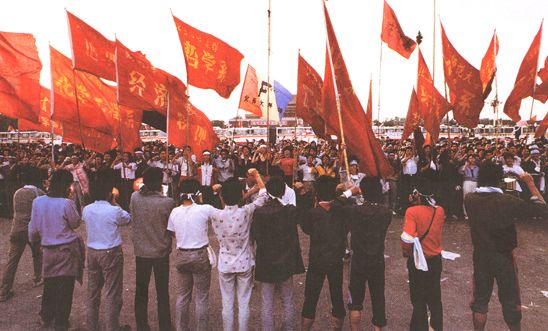
Back in May 1989 the world watched as student led demonstrations calling for greater democracy and an end to government corruption occupied Beijing's Tiananmen Square as the world watched.
Then late in the evening on June 3 and into the early morning hours of June 4 the plug was pulled on the international television network's live feeds. moments later PLA troops rolled into the square with trucks and tanks firing their weapons to brutally end the protests .
Estimates of the dead ranged from 200 to 1000 people as China was universally condemned for what happened. It also produced this iconic photo of a lone Chinese man stepping in front of a tank column before being taken away by police to a still unknown fate.
It's now been 30 years since that fateful evening that impacted modern Chinese history. Despite their Chinese government's diligent efforts to scrub it or suppress any knowledge that it happened inside the country , those of us outside of China ensure that the memory of what happened in 1989 never dies.
And we must keep the memory of what happened alive for future generations so that those persons who died in Tiananmen Square didn't do so in vain.
Showing posts with label world history. Show all posts
Tuesday, June 04, 2019
Sunday, November 09, 2014
25th Anniversary Of The Fall Of The Berlin Wall
Like the Cold War and Jim Crow segregation, the Berlin Wall was a part of the world when I was born in 1962. It was erected in August 1961 to stop the flow of East Germans fleeing their 'worker's paradise' to West Germany and came down in dramatic fashion on November 9, 1989.For something that seemed like it was going to have a permanent place during my time on Earth to the point it was a tourist attraction and two US presidents made speeches near it, the stunning way events unfolded 25 years ago that brought The Wall down and several months later on October 3, 1990 led to the reunification of Germany are still mindboggling at times to me as a Cold War baby.
The Berlin Wall was such a reality in my world that I used it as a visual example of my determination NOT to do something. I would say to peeps, "That will happen when the Berlin Wall falls."
And now, within my lifetime, before the close of the 20th century, it was beginning to happen before my very eyes. The official dismantling of the Wall didn't start until the summer of 1990 and was completed in 1992
But happen it did, and the process got started 25 years ago on this date.
Labels:
anniversary,
Berlin,
Germany,
the 80's,
world history
Friday, June 06, 2014
70th Anniversary Of D-Day Invasion
70 years ago on this date on the shores of Normandy, the fate of the world was in the balance as the D-Day invasion to liberate France and Europe from the clutches of Nazi occupation began.
The largest seaborne fleet ever assembled sailed from southern English ports laden with 156, 000 British, Canadian and American troops, tanks and other weapons to land at five code named beaches along 50 miles of heavily fortified French coastline.
The 5000 ship amphibious invasion fleet was protected by a massive air umbrella of over 11,000 airplanes that flew ahead of the ships speeding south to not only drop paratroopers behind the invasion beaches but attack any German forces moving toward them by road, canal or rail.
While the British and Canadian troops landing at Gold, Juno and Sword beaches and the Americans landing at Utah Beach encountered light resistance that morning, that wasn't the case at Omaha Beach. Bad luck in terms of nothing going as planned for the American invaders and fierce German resistance at the water's edge caused over 2000 casualties and had General Omar Bradley briefly consider a withdrawal of troops from the tenuous beachhead.
But the determined attackers pushed through, eventually made their way off Bloody Omaha and inland although not at the planned rate of advance.
It wasn't a good day for the German defenders either. Their commander, Field Marshal Erwin Rommel was in Germany celebrating his wife's June 6 birthday as his command staff was occupied at a military conference. Indecision and confusion reigned from Berchtesgaden to the Normandy invasion front as the massive invasion caught them by surprise. . Attempts to move German reinforcements to the area met savage air attacks by the Allied aircraft that ruled the skies.
By the end of the day the Allies would be starting the liberation of France and Western Europe. The five separate landing beaches would be linked into a single front containing a half million men by the end of the week being reinforced by thousands of tanks tasked for the breakout from the Normandy region in Operation Cobra. Paris was liberated by August and nearly a year later, the European phase of the war ended as Germany surrendered.
The stories of that day have been written in endless books, articles and told in documentaries and movies such as The Longest Day. But without the ultimate sacrifices of these 9000 men that we remember 70 years later, the world might be a far different place.
Wednesday, June 04, 2014
Today's The 25th Anniversary Of A Massacre..
The world will never forget. It's the 25th anniversary of the June 4, 1989 Tiananmen Square massacre in which it is estimated that up to 1000 people died after PLA troops and tanks were called in to brutally crush a five week old democracy demonstration by students in the square.
Never forget that day. Also never forget that freedom require eternal vigilance to maintain it from the external and internal enemies determined to crush it.
Saturday, November 02, 2013
30th Anniversary of Able Archer 83
I wrote last year about the 50th anniversary of the Cuban Missile Crisis that nearly led to a global nuclear war. Today is the 30th anniversary of the start of the ten day 1983 NATO Able Archer nuclear exercise that almost triggered another one.
According to a 1997 CIA analysis by Benjamin Fischer, the incident had its roots in Soviet anxiety over the US defense buildup that began during the Carter Administration. The Russians knew they couldn't compete spending and technology wise and feared they would soon be outgunned.
The USSR was also spooked by stepped-up probes of their early-warning intelligence system and other mind games played by the American military starting shortly after Ronald Reagan took office in January 1981.
Whatever the impetus, the Soviet leaders persuaded themselves the US was planning a sneak nuclear attack on the USSR and in 1981 under then KGB Chairman Yuri Andropov ordered their spies to look for evidence in an effort incongruously code-named RYAN, the Russian acronym for "nuclear missile attack."
According to a 1997 CIA analysis by Benjamin Fischer, the incident had its roots in Soviet anxiety over the US defense buildup that began during the Carter Administration. The Russians knew they couldn't compete spending and technology wise and feared they would soon be outgunned.
The USSR was also spooked by stepped-up probes of their early-warning intelligence system and other mind games played by the American military starting shortly after Ronald Reagan took office in January 1981.
Whatever the impetus, the Soviet leaders persuaded themselves the US was planning a sneak nuclear attack on the USSR and in 1981 under then KGB Chairman Yuri Andropov ordered their spies to look for evidence in an effort incongruously code-named RYAN, the Russian acronym for "nuclear missile attack."
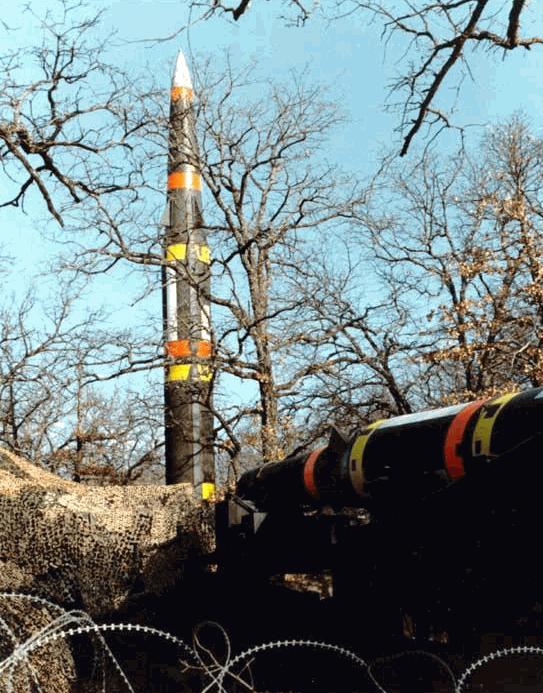
Soviet nuclear first strike fears were heightened a few more levels in February 1983. The US prepared to counter the Warsaw Pact conventional arms numerical superiority in Europe augmented by deployment of the mobile Soviet SS-20 intermediate range missiles against NATO by stepping up their conventional military readiness in the region and deploying their own next-generation mobile Pershing II intermediate range nuclear missiles in West Germany.
From their West German bases the Pershing II missiles could reach hardened targets in the Soviet Union in just four to ten minutes.
It also didn't help during this period of heightened tension and deteriorating relations between the two superpowers President Reagan was also ratcheting up the anti-Soviet rhetoric by denouncing the USSR in March as an "evil empire" and shortly afterward announced the SDI "Star Wars" missile-defense initiative designed to create a missile defense shield to make the US invulnerable to Russian nukes. The mere thought of American military R&D being put to work to make that a reality put the Soviets aging leadership team now headed by a gravely ill Yuri Andropov and their military and Strategic Rocket Forces commanders in freak out mode.
On September 1 Soviet air defense military units in the Far East, under pressure from their upper echelon political and military leadership for responding lackadaisically to previous US military air incursions during Fleet Ex 83 conducted in the North Pacific Ocean, shot down Korean Air Lines Flight 007, which had strayed into Russian airspace and been misidentified as a spy plane. All 269 passengers and crew aboard the flight were killed, including US congressman Lawrence McDonald who was headed to South Korea. Former president Richard Nixon was supposed to be on that flight seated next to McDonald but decided not to go on that trip at the last moment.
The US condemned the attack as evidence of Soviet barbarism and the increased worldwide anti-Soviet attitudes and revulsion for the attack on KAL 007 greased the political and public opinion skids to begin the European deployment of the Pershing II's.
Soviet leaders were making the counterargument (and to some extent believed) that the KAL 007 incident was an intentional US provocation and declared that accommodation with the US was impossible.
We also didn't know at the time that in the early morning hours of September 26 if it hadn't been for the cool headed thinking of duty officer Stanislav Petrov, we would have plunged that day into a accidental nuclear war.
Lieutenant Colonel Petrov, who was fortuitously on duty doing an extra shift in the air defense bunker in the Moscow area that day was faced with malfunctioning computers and blaring alarms all over his control bunker telling him five missiles had been launched from US territory. He knew that if the real thing were happening, the US wouldn't be launching just one to five Minuteman III missiles at the USSR. Petrov correctly dismissed it as a false alarm and didn't report it to his superiors in breach of Soviet military protocols. If he'd wanted to play it safe, Petrov would have informed the higher authority immediately.
Had he done so, knowing that Soviet armed forces policy was launch on warning, it probably would have resulted in a first strike attack that killed millions of people based on the mentality of the senior Soviet leadership at the time believing the US was already making preparations to do so and Reagan would order it. Subsequent investigations proved Petrov was correct and the false alarms were caused by a rare alignment of sunlight on high-altitude clouds and the Molniya satellites' orbits.
Further complicating matters and adding to the tense and worsening diplomatic relations between the superpowers was the October 25 invasion of Grenada by US forces in the wake of a Marxist coup in that island nation that led to the Cubans building a military aircraft capable airstrip on the island that concerned the US. The invasion of Grenada took place two days after the suicide bombing of the US Marine Corps barracks in Beirut, Lebanon that killed 241 American military personnel there.
From their West German bases the Pershing II missiles could reach hardened targets in the Soviet Union in just four to ten minutes.
It also didn't help during this period of heightened tension and deteriorating relations between the two superpowers President Reagan was also ratcheting up the anti-Soviet rhetoric by denouncing the USSR in March as an "evil empire" and shortly afterward announced the SDI "Star Wars" missile-defense initiative designed to create a missile defense shield to make the US invulnerable to Russian nukes. The mere thought of American military R&D being put to work to make that a reality put the Soviets aging leadership team now headed by a gravely ill Yuri Andropov and their military and Strategic Rocket Forces commanders in freak out mode.
The US condemned the attack as evidence of Soviet barbarism and the increased worldwide anti-Soviet attitudes and revulsion for the attack on KAL 007 greased the political and public opinion skids to begin the European deployment of the Pershing II's.
Soviet leaders were making the counterargument (and to some extent believed) that the KAL 007 incident was an intentional US provocation and declared that accommodation with the US was impossible.
Lieutenant Colonel Petrov, who was fortuitously on duty doing an extra shift in the air defense bunker in the Moscow area that day was faced with malfunctioning computers and blaring alarms all over his control bunker telling him five missiles had been launched from US territory. He knew that if the real thing were happening, the US wouldn't be launching just one to five Minuteman III missiles at the USSR. Petrov correctly dismissed it as a false alarm and didn't report it to his superiors in breach of Soviet military protocols. If he'd wanted to play it safe, Petrov would have informed the higher authority immediately.
Had he done so, knowing that Soviet armed forces policy was launch on warning, it probably would have resulted in a first strike attack that killed millions of people based on the mentality of the senior Soviet leadership at the time believing the US was already making preparations to do so and Reagan would order it. Subsequent investigations proved Petrov was correct and the false alarms were caused by a rare alignment of sunlight on high-altitude clouds and the Molniya satellites' orbits.
Further complicating matters and adding to the tense and worsening diplomatic relations between the superpowers was the October 25 invasion of Grenada by US forces in the wake of a Marxist coup in that island nation that led to the Cubans building a military aircraft capable airstrip on the island that concerned the US. The invasion of Grenada took place two days after the suicide bombing of the US Marine Corps barracks in Beirut, Lebanon that killed 241 American military personnel there.
But this year's version of Able Archer involved an unusually realistic buildup to a simulated NATO nuclear strike involving the NATO senior political leadership like British PM Margaret Thatcher, West German Chancellor Helmut Kohl and command and control levels of NATO that was scheduled to last ten days. President Reagan and Vice President Bush were supposed to take part in it but decided not to.
The Soviets knew Able Archer was happening but wondered if something else was afoot, having long planned to use war games as a cover for launching a first strike themselves and suspecting the US might do likewise. The Soviets also had the attitude the only way to preempt a first strike if that is what the US and NATO were gearing up for was to beat them to it and launch their own. They raised their own state of alert to a wartime footing in order to be in a better position to do so if the attack confirmation intel came from the RYAN protocol.
The increased coded traffic picked up by the KGB between Washington and London in reality was chippy diplomatic chatter being generated because Great Britain was pissed about the Grenada invasion but was being read by RYAN analysts as coordination communication prior to launching an attack.
But the coded traffic combined with NATO forces simulating during the Able Archer 83 exercises the moves and communications necessary to transition from a conventional to nuclear conflict through all alert phases, from DEFCON 5 to DEFCON 1 led alarmist KGB agents to mistakenly report them as part of the Soviet RYAN intel gathering protocols as actual preparations for a NATO first strike on the USSR.
The result was the Baltic Military District in the USSR being placed on alert status along with units in Czechoslovakia, nuclear capable aircraft units in Poland and East Germany being activated and prepped for action and Strategic Rocket Forces ICBM silos and units prepped for launch as the Soviet leadership frantically sent high-priority telegrams from Moscow to its KGB stations in Western Europe on November 8 demanding information about the feared surprise NATO nuclear first strike attack on the USSR.
The CIA picked up on the increased military and civilian leadership communications activity on the Soviet side, but didn't connect it to Able Archer. Neither did they pick up on the USSR leadership's paranoid national beliefs since 1982 that it was backed into a global strategic military corner and their only way out of it was to launch a first strike.
Granted, the most recent example being World War II of Russia being surprise attacked gave them a reason to be wary, but the USSR's 'America's Going To Nuke Us' paranoia almost ended up triggering World War III.
Little did we realize at the time how prophetic those songs and movies almost became.
Those anxieties eased a bit with the end of the Able Archer exercise, the subsequent death of Yuri Andropov in February 1984 and the restarting of INF treaty talks with the USSR. But it's sobering and scary to think about the fact the world once again by the slimmest of margins barely escaped nuclear annihilation.
Labels:
history,
military,
NATO,
nuclear war,
the 80's,
USA,
USSR,
wargames,
Warsaw Pact,
world history
Sunday, October 06, 2013
40th Anniversary Of The Yom Kippur War
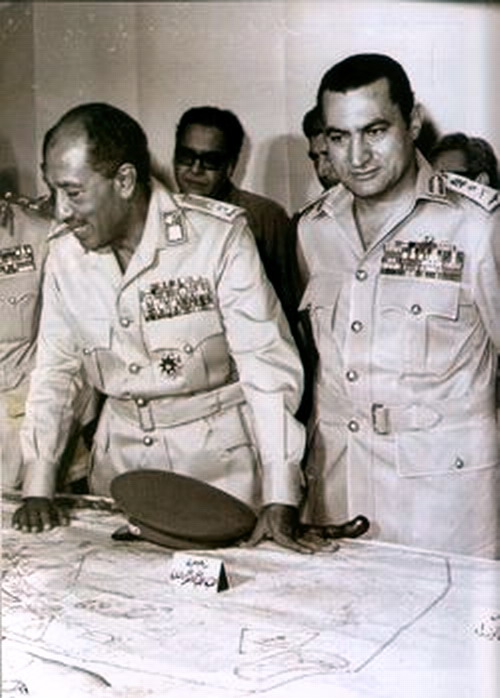
Today marks the 40th anniversary of the start of the 1973 Yom Kippur war between a coalition of Arab states led by Egypt and Syria against Israel that started on the holiest day of the Jewish calendar.
That year the Muslim holy month of Ramadan occurred during that time period, so it's also known as the Ramadan War in the Arab world.
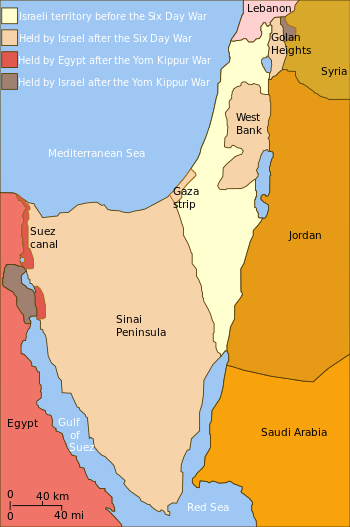
It had its roots in the devastating and humiliating defeat the Arab coalition of Egypt, Syria and Jordan suffered in June 1967 during the Six Day War. It resulted in Israel not only obliterating the air forces of Egypt, Jordan and Syria in a surprise preemptive attack but also capturing East Jerusalem and the West Bank of Jordan, Syria's Golan Heights and the Gaza Strip and the Sinai Peninsula from Egypt in a swift combined arms ground attack supported by an Israeli Air Force with uncontested control of the skies.
The decisive Israeli military victory and subsequent occupation of all that previously Arab held territory four time the size of Israel itself made the stinging 1967 blitzkrieg defeat handed them by the IDF impossible to forget for the Arab coalition. Meanwhile the ease of their victory in addition to making it clear to the world Israel was the preeminent military power in the region led to the Israel Defense Forces becoming complacent and arrogantly dismissive about the military capabilities of their Arab neighbors.
In the years leading up to 1973 new leaders took over during that period in the faces of Anwar Sadat in Egypt and Hafez al-Assad in Syria. Egypt and Syria rebuilt their military might with the latest Soviet weaponry in preparation to take on Israel and regain their pride and honor. As they did so the IDF continued to train and hone their tactics as their combat engineers built the Bar-Lev Line along the Suez Canal's east bank complete with an 18 meter high (59 feet) sand wall sloping at a 60 degree angle reinforced by concrete at the waters edge.
In the Golan Heights Israeli combat engineers dug a 32 km (20 mile) long anti-tank ditch from Mount Hermon to Rafid along the length of the Purple Line, the UN monitored cease fire line between the two nations.
Egypt also erected a dense SAM missile belt along the entire west bank of the Suez Canal designed to keep the Israeli Air Force at bay as they secretly rehearsed their plans to rapidly cross the Suez Canal and seize the Sinai. Syria did the same on their side of the Purple Line augmented by the latest Soviet anti-aircraft artillery and SAM's as they planned their military campaign to recapture the Golan Heights.
At 2:00 PM on October 6, 1973 Egypt and Syria launched Operation Badr, their coordinated surprise attack on the Sinai and Golan Heights fronts on Yom Kippur, the Jewish Day of Atonement and the holiest day on the Jewish calendar. It caught the Israeli Defense Forces off guard and away from their posts.
Even worse for the IDF, there were skeleton forces defending both the Bar-Lev Line and the Golan Heights because of the holiday and no time to call up their reserves or calibrate their equipment before immediately deploy them to both fronts. Neither was their time for the Israeli Air Force to launch effective suppression missions against the Egyptian and Syrian SAM belts.
On the Sinai front facing the five Egyptian divisions totaling 100,000 soldiers, 1,350 tanks and 2,000 guns and heavy mortars tasked to regain the Sinai were 450 soldiers of the Jerusalem Brigade, spread out in the 16 Bar-Lev Line forts along the length of the Canal and 290 Israeli tanks in the entire Sinai peninsula divided into three armored brigades. Only one of those armored brigades was near the Suez Canal when hostilities started.
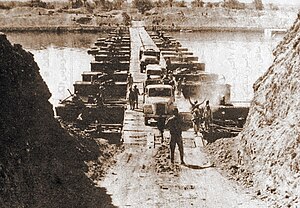
The Egyptians crossed the Suez Canal at five points, breached the steeply sloped sand banks and quickly overwhelmed 15 of the sixteen spaced out forts guarding the eastern bank of the canal. After repelling several piecemeal Israeli counterattacks and the Egyptian SAM umbrella does its job of keeping the Israeli Air Force at bay, after three days of fighting they settle into a stalemate as Israeli reinforcements arrive in the combat zone and the IDF elects to build up their forces before resuming the battle.
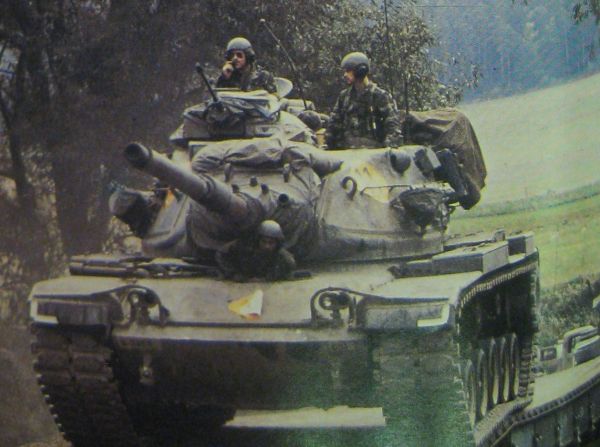
In the Golan Heights, two Israeli brigades of 3,000 troops, 180 tanks and 60 artillery pieces faced a classic Soviet-style combined arms frontal assault conducted by the Syrian 5th, 7th and 9th mechanized infantry divisions with large armour components comprising 28,000 Syrian troops, 800 tanks and 600 artillery pieces with the Syrian 1st and 3rd Armored divisions deployed in the follow up attacks.
At 2:00 PM Syria begins their portion of the coordinated attack with a massive artillery barrage and supporting air strikes.along the entire 57 km (36 mile) Golan front. A heliborne troop assault is also launched at the Israeli outpost on the slopes of Mt. Hermon that oversaw the entire area
While the Syrian units attacking in the northern Golan were held up for four days because of the rocky terrain and heavy losses inflicted on them by Israel's 7th Armored Brigade, the Syrians successfully overwhelm the Mt. Hermon garrison and their southern units break through and obliterate the 188th Barak Armored Brigade in the flatter terrain of the southern Golan.
The Syrians get within an agonizingly close 10 minute drive to their targets, the Bnot Yaakov Bridge over the Jordan River and the Arik Bridge near the northern Sea of Galilee that lead into northern Israel before an inexplicable overnight pause by the Syrians and Israeli reserve forces arriving in the area in the nick of time save the day. They contain the Syrian advance, push them back to the pre-war start lines and Israel then launches on October 10 a four day counteroffensive that eventually brought them within 40 km (25 miles) of Damascus
In the early days of the Yom Kippur War with the successful Egyptian canal crossing, Syrian tanks approaching the Jordan River and northern Israel and fearing the war was lost, the conflict almost went nuclear. The orders were given to assemble thirteen 20 kiloton tactical nukes at two airbases on the night of October 8-9 and use them on the Sinai and Golan fronts.
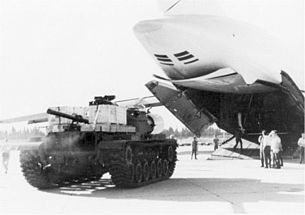
The Israeli nuclear preparations alarmed both the Soviets and the US and triggered Operation Nickel Grass, a resupply airlift to Israel that commenced October 10 after the Soviets did the same via air and sea for their Arab client states. The US also launched an SR-71 recon mission over the area that gave the Israelis critical intel for future military operations.
President Sadat, worried about the success of the Israeli Golan Heights offensive and the military cohesion of his Syrian ally, ordered a massive Egyptian armored offensive on October 14 to capture the Mitla and Gidi passes in the central Sinai that was quickly repulsed with heavy losses.
The Israelis on October 16 launched Operation Gazelle, an offensive to split the gap between the Egyptian Second and Third Armies detected by the SR-71 mission and cross the Suez Canal at Deversoir on the northern edge of the Great Bitter Lake. Once ensconced on the west bank, the 20 tanks and 7 APCs that made the initial crossing formed a raiding party that attacked Egyptian SAM sites and military columns with impunity. By destroying the SAM's, it allowed the Israeli Air Force to join the fray and flex its power as the ground forces continued to widen, deepen and expand their African Egypt bridgehead.
The Israeli offensives on both fronts continued to the point that on the Golan front they were in the process of retaking all the positions they lost on Mt Hermon. and were 16 km (10 miles) from Damascus.
On the Egyptian front the IDF was 64 km (40 miles) from Cairo, had the Egyptian Third Army surrounded and trapped with the Great Bitter Lake to their rear, and in the Ismailia and Suez City outskirts.
October 20 saw the unanimous passage of UN Security Resolution 338, which called for an immediate cease-fire, the implementation of Security Resolution 242, which called for an exchange of land for peace and negotiations between the “parties concerned” aimed at establishing a “just and durable peace.”
The first cease fire attempt fails with both sides accusing the other of violating it. The UN Security Council then passes Security Resolution 339, which basically restates what 338 said with the addition of UN observers. Syria accepts that cease fire on October 23, but the fighting still continues between Egyptian and Israeli forces on their front.
It almost escalated into an armed clash between US and Soviet forces. The Soviets activated their seven elite paratroop divisions, sent 40,000 naval infantry troops to the Mediterranean Sea on seven amphibious warfare ships, put some southern USSR air units on alert and threatened to intervene on behalf of the Arab nations and the surrounded Egyptian Third Army. The US responded by going from DEFCON 4 to DEFCON 3, putting nuclear forces on alert and threatening to intervene on behalf of Israel.
That also caused the IDF to put their nuclear forces on alert again before cooler heads prevailed to ratchet down the tension and seek a Soviet-US brokered solution that led to a October 25 cease fire on the Egyptian front On October 28 Egyptian and Israeli military met at the Kilometer 101 marker in the Sinai to conduct their first meeting in 25 years to discuss plans for implementing the cease fire.
While the Yom Kippur War was a short duration one of three weeks, it was a costly one with far reaching ripple effects. The Israelis lost 2800 soldiers with over 8800 wounded. The Arab coalition forces suffered 18,500 dead with 35,000 wounded.
The Arab OPEC nations launched an oil embargo on October 17 aimed at the United States, Japan and Western European nations that wasn't lifted until March 1974.
Because the IDF was caught off guard, Prime Minister Golda Meir's Alignment Party paid dearly for it in the December 1973 Israeli elections, losing five Knesset seats. Meir later resigned along with her entire cabinet and Defense Minster Moshe Dayan on April 11, 1974. It resulted in Yitzhak Rabin beating Shimon Peres for the leadership of the Alignment Party and later becoming Israel's Prime Minister in June 1974. It also to increased respect for the military abilities of the Arab nations and decreased confidence in the abilities of the IDF to defeat the Arab coalition in a subsequent war despite being the preeminent military nation in the Middle East.
That new reality and status quo in the Middle East led to Egypt and Israel heading to the negotiating table for the 1978 Camp David Accords and signing the Egypt-Israel Peace Treaty a year later
For the Arab coalition, it shattered the Israeli military invincibility myth, healed the psychological wounds from the 1967 defeat and earned them the political capital of negotiating with the Israelis as equals. It also made Anwar Sadat a hero in Egypt.
I say Arab coalition because there were nine other nations involved besides the Egyptian and Syrians. Iraq sent a squadron of Hunter jets to Egypt, deployed MiG's as early as October 8 and deployed a division comprised of 18,000 men, and several hundred tanks in the central Golan. Saudi Arabia and Kuwait were fiscal underwriters of the war along with the Saudis sending a 3000 man brigade to Syria. Jordan and King Hussein were reluctant participants in Syria and Libya sent Mirage fighters to Egypt. .
The late reversals in the war also convinced the Arab coalition and many in the Arab world that despite their improved fighting capability since 1967, Israel couldn't be eradicated by force of arms, strengthening the hand of peace movements seeking negotiated settlements in the Middle East.
Both sides would honor and bury their dead and tend to their wounded warriors as another Arab-Israeli conflict came to a close.
That year the Muslim holy month of Ramadan occurred during that time period, so it's also known as the Ramadan War in the Arab world.
It had its roots in the devastating and humiliating defeat the Arab coalition of Egypt, Syria and Jordan suffered in June 1967 during the Six Day War. It resulted in Israel not only obliterating the air forces of Egypt, Jordan and Syria in a surprise preemptive attack but also capturing East Jerusalem and the West Bank of Jordan, Syria's Golan Heights and the Gaza Strip and the Sinai Peninsula from Egypt in a swift combined arms ground attack supported by an Israeli Air Force with uncontested control of the skies.
In the years leading up to 1973 new leaders took over during that period in the faces of Anwar Sadat in Egypt and Hafez al-Assad in Syria. Egypt and Syria rebuilt their military might with the latest Soviet weaponry in preparation to take on Israel and regain their pride and honor. As they did so the IDF continued to train and hone their tactics as their combat engineers built the Bar-Lev Line along the Suez Canal's east bank complete with an 18 meter high (59 feet) sand wall sloping at a 60 degree angle reinforced by concrete at the waters edge.
In the Golan Heights Israeli combat engineers dug a 32 km (20 mile) long anti-tank ditch from Mount Hermon to Rafid along the length of the Purple Line, the UN monitored cease fire line between the two nations.
Egypt also erected a dense SAM missile belt along the entire west bank of the Suez Canal designed to keep the Israeli Air Force at bay as they secretly rehearsed their plans to rapidly cross the Suez Canal and seize the Sinai. Syria did the same on their side of the Purple Line augmented by the latest Soviet anti-aircraft artillery and SAM's as they planned their military campaign to recapture the Golan Heights.
Even worse for the IDF, there were skeleton forces defending both the Bar-Lev Line and the Golan Heights because of the holiday and no time to call up their reserves or calibrate their equipment before immediately deploy them to both fronts. Neither was their time for the Israeli Air Force to launch effective suppression missions against the Egyptian and Syrian SAM belts.
On the Sinai front facing the five Egyptian divisions totaling 100,000 soldiers, 1,350 tanks and 2,000 guns and heavy mortars tasked to regain the Sinai were 450 soldiers of the Jerusalem Brigade, spread out in the 16 Bar-Lev Line forts along the length of the Canal and 290 Israeli tanks in the entire Sinai peninsula divided into three armored brigades. Only one of those armored brigades was near the Suez Canal when hostilities started.
The Egyptians crossed the Suez Canal at five points, breached the steeply sloped sand banks and quickly overwhelmed 15 of the sixteen spaced out forts guarding the eastern bank of the canal. After repelling several piecemeal Israeli counterattacks and the Egyptian SAM umbrella does its job of keeping the Israeli Air Force at bay, after three days of fighting they settle into a stalemate as Israeli reinforcements arrive in the combat zone and the IDF elects to build up their forces before resuming the battle.
In the Golan Heights, two Israeli brigades of 3,000 troops, 180 tanks and 60 artillery pieces faced a classic Soviet-style combined arms frontal assault conducted by the Syrian 5th, 7th and 9th mechanized infantry divisions with large armour components comprising 28,000 Syrian troops, 800 tanks and 600 artillery pieces with the Syrian 1st and 3rd Armored divisions deployed in the follow up attacks.
While the Syrian units attacking in the northern Golan were held up for four days because of the rocky terrain and heavy losses inflicted on them by Israel's 7th Armored Brigade, the Syrians successfully overwhelm the Mt. Hermon garrison and their southern units break through and obliterate the 188th Barak Armored Brigade in the flatter terrain of the southern Golan.
The Syrians get within an agonizingly close 10 minute drive to their targets, the Bnot Yaakov Bridge over the Jordan River and the Arik Bridge near the northern Sea of Galilee that lead into northern Israel before an inexplicable overnight pause by the Syrians and Israeli reserve forces arriving in the area in the nick of time save the day. They contain the Syrian advance, push them back to the pre-war start lines and Israel then launches on October 10 a four day counteroffensive that eventually brought them within 40 km (25 miles) of Damascus
The Israeli nuclear preparations alarmed both the Soviets and the US and triggered Operation Nickel Grass, a resupply airlift to Israel that commenced October 10 after the Soviets did the same via air and sea for their Arab client states. The US also launched an SR-71 recon mission over the area that gave the Israelis critical intel for future military operations.
President Sadat, worried about the success of the Israeli Golan Heights offensive and the military cohesion of his Syrian ally, ordered a massive Egyptian armored offensive on October 14 to capture the Mitla and Gidi passes in the central Sinai that was quickly repulsed with heavy losses.
The Israelis on October 16 launched Operation Gazelle, an offensive to split the gap between the Egyptian Second and Third Armies detected by the SR-71 mission and cross the Suez Canal at Deversoir on the northern edge of the Great Bitter Lake. Once ensconced on the west bank, the 20 tanks and 7 APCs that made the initial crossing formed a raiding party that attacked Egyptian SAM sites and military columns with impunity. By destroying the SAM's, it allowed the Israeli Air Force to join the fray and flex its power as the ground forces continued to widen, deepen and expand their African Egypt bridgehead.
On the Egyptian front the IDF was 64 km (40 miles) from Cairo, had the Egyptian Third Army surrounded and trapped with the Great Bitter Lake to their rear, and in the Ismailia and Suez City outskirts.
October 20 saw the unanimous passage of UN Security Resolution 338, which called for an immediate cease-fire, the implementation of Security Resolution 242, which called for an exchange of land for peace and negotiations between the “parties concerned” aimed at establishing a “just and durable peace.”
The first cease fire attempt fails with both sides accusing the other of violating it. The UN Security Council then passes Security Resolution 339, which basically restates what 338 said with the addition of UN observers. Syria accepts that cease fire on October 23, but the fighting still continues between Egyptian and Israeli forces on their front.
It almost escalated into an armed clash between US and Soviet forces. The Soviets activated their seven elite paratroop divisions, sent 40,000 naval infantry troops to the Mediterranean Sea on seven amphibious warfare ships, put some southern USSR air units on alert and threatened to intervene on behalf of the Arab nations and the surrounded Egyptian Third Army. The US responded by going from DEFCON 4 to DEFCON 3, putting nuclear forces on alert and threatening to intervene on behalf of Israel.
That also caused the IDF to put their nuclear forces on alert again before cooler heads prevailed to ratchet down the tension and seek a Soviet-US brokered solution that led to a October 25 cease fire on the Egyptian front On October 28 Egyptian and Israeli military met at the Kilometer 101 marker in the Sinai to conduct their first meeting in 25 years to discuss plans for implementing the cease fire.
The Arab OPEC nations launched an oil embargo on October 17 aimed at the United States, Japan and Western European nations that wasn't lifted until March 1974.
Because the IDF was caught off guard, Prime Minister Golda Meir's Alignment Party paid dearly for it in the December 1973 Israeli elections, losing five Knesset seats. Meir later resigned along with her entire cabinet and Defense Minster Moshe Dayan on April 11, 1974. It resulted in Yitzhak Rabin beating Shimon Peres for the leadership of the Alignment Party and later becoming Israel's Prime Minister in June 1974. It also to increased respect for the military abilities of the Arab nations and decreased confidence in the abilities of the IDF to defeat the Arab coalition in a subsequent war despite being the preeminent military nation in the Middle East.
For the Arab coalition, it shattered the Israeli military invincibility myth, healed the psychological wounds from the 1967 defeat and earned them the political capital of negotiating with the Israelis as equals. It also made Anwar Sadat a hero in Egypt.
I say Arab coalition because there were nine other nations involved besides the Egyptian and Syrians. Iraq sent a squadron of Hunter jets to Egypt, deployed MiG's as early as October 8 and deployed a division comprised of 18,000 men, and several hundred tanks in the central Golan. Saudi Arabia and Kuwait were fiscal underwriters of the war along with the Saudis sending a 3000 man brigade to Syria. Jordan and King Hussein were reluctant participants in Syria and Libya sent Mirage fighters to Egypt. .
The late reversals in the war also convinced the Arab coalition and many in the Arab world that despite their improved fighting capability since 1967, Israel couldn't be eradicated by force of arms, strengthening the hand of peace movements seeking negotiated settlements in the Middle East.
Both sides would honor and bury their dead and tend to their wounded warriors as another Arab-Israeli conflict came to a close.
Labels:
Egypt,
Israel,
Syria,
the 70's,
the Cold War,
the Middle East,
war,
world history
Subscribe to:
Posts (Atom)