Showing posts with label Israel. Show all posts

Sunday, October 06, 2013

40th Anniversary Of The Yom Kippur War

Today marks the 40th anniversary of the start of the 1973 Yom Kippur war between a coalition of Arab states led by Egypt and Syria against Israel that started on the holiest day of the Jewish calendar.

That year the Muslim holy month of Ramadan occurred during that time period, so it's also known as the Ramadan War in the Arab world.  

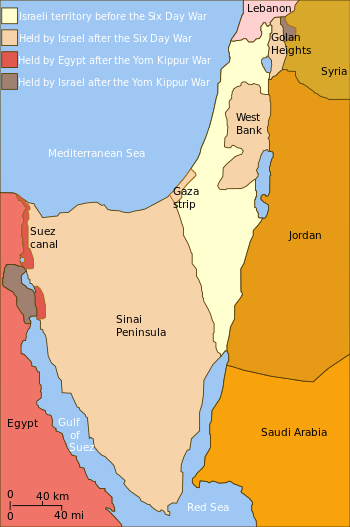
It had its roots in the devastating and humiliating defeat the Arab coalition of Egypt, Syria and Jordan suffered in June 1967 during the Six Day War.  It resulted in Israel not only obliterating the air forces of Egypt, Jordan and Syria in a surprise preemptive attack but also capturing East Jerusalem and the West Bank of Jordan, Syria's Golan Heights and the Gaza Strip and the Sinai Peninsula from Egypt in a swift combined arms ground attack supported by an Israeli Air Force with uncontested control of the skies. 
The decisive Israeli military victory and subsequent occupation of all that previously Arab held territory four time the size of Israel itself made the stinging 1967 blitzkrieg defeat handed them by the IDF impossible to forget for the Arab coalition.   Meanwhile the ease of their victory in addition to making it clear to the world Israel was the preeminent military power in the region led to the Israel Defense Forces becoming complacent and arrogantly dismissive about the military capabilities of their Arab neighbors.  

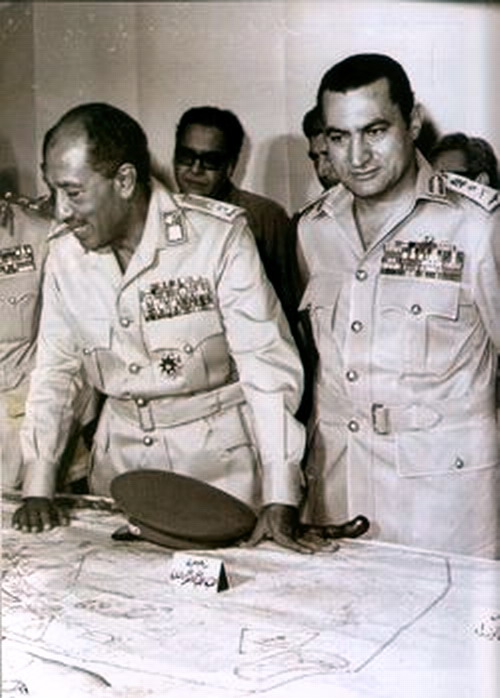
In the years leading up to 1973 new leaders took over during that period in the faces of Anwar Sadat in Egypt and Hafez al-Assad in Syria.   Egypt and Syria rebuilt their military might with the latest Soviet weaponry in preparation to take on Israel and regain their pride and honor.  As they did so the IDF continued to train and hone their tactics as their combat engineers built the Bar-Lev Line along the Suez Canal's east bank complete with an 18 meter high (59 feet) sand wall sloping at a 60 degree angle reinforced by concrete at the waters edge.  

In the Golan Heights Israeli combat engineers dug a 32 km (20 mile) long anti-tank ditch from Mount Hermon to Rafid along the length of the Purple Line, the UN monitored cease fire line between the two nations.  

Egypt also erected a dense SAM missile belt along the entire west bank of the Suez Canal designed to keep the Israeli Air Force at bay as they secretly rehearsed their plans to rapidly cross the Suez Canal and seize the Sinai.  Syria did the same on their side of the Purple Line augmented by the latest Soviet anti-aircraft artillery and SAM's as they planned their military campaign to recapture the Golan Heights.
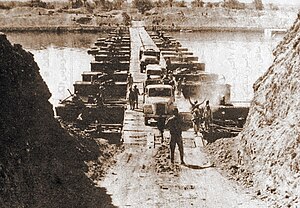
Bridge Crossing.jpgAt 2:00 PM on October 6, 1973 Egypt and Syria launched Operation Badr, their coordinated surprise attack on the Sinai and Golan Heights fronts on Yom Kippur, the Jewish Day of Atonement and the holiest day on the Jewish calendar. It caught the Israeli Defense Forces off guard and away from their posts.

Even worse for the IDF, there were skeleton forces defending both the Bar-Lev Line and the Golan Heights because of the holiday and no time to call up their reserves or calibrate their equipment before immediately deploy them to both fronts.  Neither was their time for the Israeli Air Force to launch effective suppression missions against the Egyptian and Syrian SAM belts. 

On the Sinai front facing the five Egyptian divisions totaling 100,000 soldiers, 1,350 tanks and 2,000 guns and heavy mortars tasked to regain the Sinai were 450 soldiers of the Jerusalem Brigade, spread out in the 16 Bar-Lev Line forts along the length of the Canal and 290 Israeli tanks in the entire Sinai peninsula divided into three armored brigades.  Only one of those armored brigades was near the Suez Canal when hostilities started.

The Egyptians crossed the Suez Canal at five points, breached the steeply sloped sand banks and quickly overwhelmed 15 of the sixteen spaced out forts guarding the eastern bank of the canal.   After repelling several piecemeal Israeli counterattacks and the Egyptian SAM umbrella does its job of keeping the Israeli Air Force at bay, after three days of fighting they settle into a stalemate as Israeli reinforcements arrive in the combat zone and the IDF elects to build up their forces before resuming the battle. 

In the Golan Heights, two Israeli brigades of 3,000 troops, 180 tanks and 60 artillery pieces faced a classic Soviet-style combined arms frontal assault conducted by the Syrian 5th, 7th and 9th mechanized infantry divisions with large armour components comprising 28,000 Syrian troops, 800 tanks and 600 artillery pieces with the Syrian 1st and 3rd Armored divisions deployed in the follow up attacks.   

At 2:00 PM Syria begins their portion of the coordinated attack with a massive artillery barrage and supporting air strikes.along the entire 57 km (36 mile) Golan front. A heliborne troop assault is also launched at the Israeli outpost on the slopes of Mt. Hermon that oversaw the entire area  

While the Syrian units attacking in the northern Golan were held up for four days because of the rocky terrain and heavy losses inflicted on them by Israel's 7th Armored Brigade, the Syrians successfully overwhelm the Mt. Hermon garrison and their southern units break through and obliterate the 188th Barak Armored Brigade in the flatter terrain of the southern Golan.  

The Syrians get within an agonizingly close 10 minute drive to their targets, the Bnot Yaakov Bridge over the Jordan River and the Arik Bridge near the northern Sea of Galilee that lead into northern Israel before an inexplicable overnight pause by the Syrians and Israeli reserve forces arriving in the area in the nick of time save the day.  They contain the Syrian advance, push them back to the pre-war start lines and Israel then launches on October 10 a four day counteroffensive that eventually brought them within 40 km (25 miles) of Damascus 
In the early days of the Yom Kippur War with the successful Egyptian canal crossing, Syrian tanks approaching the Jordan River and northern Israel and fearing the war was lost, the conflict almost went nuclear.  The orders were given to assemble thirteen 20 kiloton tactical nukes at two airbases on the night of October 8-9 and use them on the Sinai and Golan fronts. 

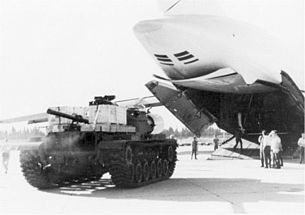
The Israeli nuclear preparations alarmed both the Soviets and the US and triggered Operation Nickel Grass, a resupply airlift to Israel that commenced October 10 after the Soviets did the same via air and sea for their Arab client states. The US also launched an SR-71 recon mission over the area that gave the Israelis critical intel for future military operations.

President Sadat, worried about the success of the Israeli Golan Heights offensive and the military cohesion of his Syrian ally, ordered a massive Egyptian armored offensive on October 14 to capture the Mitla and Gidi passes in the central Sinai that was quickly repulsed with heavy losses.   

The Israelis on October 16 launched Operation Gazelle, an offensive to split the gap between the Egyptian Second and Third Armies detected by the SR-71 mission and cross the Suez Canal at Deversoir on the northern edge of the Great Bitter Lake.  Once ensconced on the west bank, the 20 tanks and 7 APCs that made the initial crossing formed a raiding party that attacked Egyptian SAM sites and military columns with impunity. By destroying the SAM's,  it allowed the Israeli Air Force to join the fray and flex its power as the ground forces continued to widen, deepen and expand their African Egypt bridgehead.   

The Israeli offensives on both fronts continued to the point that on the Golan front they were in the process of retaking all the positions they lost on Mt Hermon. and were 16 km (10 miles) from Damascus.

On the Egyptian front the IDF was 64 km (40 miles) from Cairo, had the Egyptian Third Army surrounded and trapped with the Great Bitter Lake to their rear, and in the Ismailia and Suez City outskirts.

October 20 saw the unanimous passage of UN Security Resolution 338, which called for an immediate cease-fire, the implementation of Security Resolution 242, which called for an exchange of land for peace and negotiations between the “parties concerned” aimed at establishing a “just and durable peace.”

The first cease fire attempt fails with both sides accusing the other of violating it.   The UN Security Council then passes Security Resolution 339, which basically restates what 338 said with the addition of UN observers. Syria accepts that cease fire on October 23, but the fighting still continues between Egyptian and Israeli forces on their front.  

It almost escalated into an armed clash between US and Soviet forces.  The Soviets activated their seven elite paratroop divisions, sent 40,000 naval infantry troops to the Mediterranean Sea on seven amphibious warfare ships, put some southern USSR air units on alert and threatened to intervene on behalf of the Arab nations and the surrounded Egyptian Third Army.  The US responded by going from DEFCON 4 to DEFCON 3, putting nuclear forces on alert and threatening to intervene on behalf of Israel.

That also caused the IDF to put their nuclear forces on alert again before cooler heads prevailed to ratchet down the tension and seek a Soviet-US brokered solution that led to a October 25 cease fire on the Egyptian front 
On October 28 Egyptian and Israeli military met at the Kilometer 101 marker in the Sinai to conduct their first meeting in 25 years to discuss plans for implementing the cease fire. 
While the Yom Kippur War was a short duration one of three weeks, it was a costly one with far reaching ripple effects. The Israelis lost 2800 soldiers with over 8800 wounded.  The Arab coalition forces suffered 18,500 dead with 35,000 wounded.

The Arab OPEC nations launched an oil embargo on October 17 aimed at the United States, Japan and Western European nations that wasn't lifted until March 1974.   

Because the IDF was caught off guard, Prime Minister Golda Meir's Alignment Party paid dearly for it in the December 1973 Israeli elections, losing five Knesset seats.  Meir later resigned along with her entire cabinet and Defense Minster Moshe Dayan on April 11, 1974.  It resulted in Yitzhak Rabin beating Shimon Peres for the leadership of the Alignment Party and later becoming Israel's Prime Minister in June 1974.  It also to increased respect for the military abilities of the Arab nations and decreased confidence in the abilities of the IDF to defeat the Arab coalition in a subsequent war despite being the preeminent military nation in the Middle East.

That new reality and status quo in the Middle East led to Egypt and Israel heading to the negotiating table for the 1978 Camp David Accords and signing the Egypt-Israel Peace Treaty a year later 

For the Arab coalition, it shattered the Israeli military invincibility myth, healed the psychological wounds from the 1967 defeat and earned them the political capital of negotiating with the Israelis as equals.  It also made Anwar Sadat a hero in Egypt.

I say Arab coalition because there were nine other nations involved besides the Egyptian and Syrians.  Iraq sent a squadron of Hunter jets to Egypt, deployed MiG's as early as October 8 and deployed a division comprised of 18,000 men, and several hundred tanks in the central Golan.  Saudi Arabia and Kuwait were fiscal underwriters of the war along with the Saudis sending a 3000 man brigade to Syria.  Jordan and King Hussein were reluctant participants in Syria and Libya sent Mirage fighters to Egypt. .        

The late reversals in the war also convinced the Arab coalition and many in the Arab world that despite their improved fighting capability since 1967, Israel couldn't be eradicated by force of arms, strengthening the hand of peace movements seeking negotiated settlements in the Middle East. 

Both sides would honor and bury their dead and tend to their wounded warriors as another Arab-Israeli conflict came to a close. 

Saturday, May 18, 2013

Israeli School Firing Award Winning Trans Teacher For Coming Out


Marina, an award winning mathetmatics teacher in Israel was told she faces dismissal after coming out to her students as a transgender womanThe international trans community discovered thanks to Dana International's 1998 Eurovision win that transpeople exist in Israel.

Because of the subsequent media attention Dana, other Israeli trans women and the Paper Dolls documentary garnered, Israel on the surface has the reputation in the international trans community of being the most trans friendly spot in the Middle East compared to its regional neighbors. 

But disturbing news is coming out of that nation that is making people in the international trans community question the trans friendly perception.

This one also concerns me as a proud teacher's kid.

According to Gay Star News, an award winning mathematics teacher named Marina is facing dismissal after she openly talked to her students about being a trans woman.

Marina has been and outstanding teacher and mentor for the last three years and says that Israel’s Center for Educational Technology (CET) wants her fired for merely discussing her gender identity.

Marina is justifiably shocked that this is happening especailly since there have been no complaints filed against her.  She pointed out in a Channel 2 Israel interview: ‘I tried to explain that I am a human being just like they are and that it has no bearing on me being professional, and they need to accept people as they are’


She also pointed out ongoing work with pupils includes small talk, and she refuses to hide her identity, ‘coming out should encourage teachers to come out to students to teachers so that neither teachers nor students feel ashamed of themselves’.

Eran Dey of Israel’s LGBT community Facebook page, told Gay Star News: ‘I think transgender people are the least well treated out of the LGBT community in Israel. Employees make their life a living hell if they even manage to make it through a job interview, due to prejudice.


'I find it crucial for cases like Marina’s to go before court to ensure that future employers in Israel would treat transgender and genderqueer people with dignity, equality and respect’.

Yadin Sapir, chair of Ha’vanaa, an organization dedicated to fighting against homophobia and transphobia told Gay Star News: ‘It is particularly insulting to hear a claim as if she wasn’t ‘qualified’ to speak with her students; a claim that hints that the fact she’s a transgender woman is ‘embarrassing’ to CET and requires a ‘special qualification’ when it comes to being discussed with students.

‘This highlights the need not only to bring the institution to court but also to conduct diversity training to employers in Israel’.

Wednesday, September 05, 2012

40th Anniversary Of The Munich Olympic Massacre

If you younglings are wondering why security is a major issue at every Olympic Games and what the moment of silence kerfluffle was about in the runup to the recently concluded London Games, it's because of what happened during the XX Olympic Games in Munich 40 years ago today.

On this date 11 members of the Israeli Olympic delegation and a German policeman died during a failed attempt to end the hostage standoff and rescue nine athletes being held in two helicopters at the NATO Fürstenfeldbruck airbase.  Five of the eight PLO terrorists also died during the failed rescue mission with three survivors being captured..

When Munich won the Olympic bid on April 26, 1966 to host the Games over Madrid, Montreal and Detroit concerns were expressed over the facts this would be the first Summer Olympics held in Germany since the 1936 Berlin Games and Munich was where the Nazi Party was founded and headquartered.

The (West) Germans were extremely sensitive to that history and when the Games opened on August 26, 1972 they wanted to make certain they took every opportunity to present an optimistic, happy, non-militaristic and democratic Germany to the world. 

But there were stormy political clouds intruding on that sunny picture the Germans planned to present to the world.  The IOC denied a request by the Palestine Liberation Organization for it to send a Palestinian team to the Olympic Games, and in response chatter started that retaliation would take place during the Games. There were rumblings and intelligence warnings before the Munich Games started that were unfortunately ignored that some kind of terrorist attack would take place as late as September 2. 

The Israeli Olympic delegation was understandably nervous in the runup to the Munich Games, had asked to have their own security team present, a request that for some reason was denied.   They were concerned during the Games about the lack of armed security guards patrolling the fences surrounding the Olympic Village and lax security procedures to enter and exit it once the Games started on August 26. 

In the early morning hours of September 5 eight members of the PLO terrorist group Black September scaled the two meter (six foot) fence surrounding the Olympic Village dressed in track suits, made it to the apartment building at 31 Connollystrasse housing the Israeli Olympic team, broke in, killed Youssef Romano and Moshe Weinberg, two members of the team that tried to resist the apartment invasion and took the remaining nine members hostage.  Fortunately the female members of the Israeli team were housed in a separate section of the Olympic Village, and the team members participating in the sailing events were 400 km away in Kiel.

It triggered an almost 18 hour standoff between the Black September terrorists and German authorities in which the PLO terrorists demanded the release of over 200 of their comrades in Israeli jails, Germany release the notorious Red Army Faction founders Andreas Baader and Ulrike Meinhof and be given safe passage out of the country in exchange for the Israeli hostages.

Later that evening the terrorists and their hostages were helicoptered to Fürstenfeldbruck airbase  to ostensibly be transported by air to Egypt but in reality were flying into a planned German ambush that went horribly wrong.

A firefight ensued with Anton Fliegerbauer, one of the undermanned German police team members snipers conducting the rescue operation being shot and killed in the control tower along with five of the eight Black September terrorists. 

When the remaining terrorists saw armored cars being deployed they realized their chances of holding out were over.  They shot four of the Israeli hostages on one of the helicopters and then detonated a grenade that resulted in their incineration.   The five remaining Israeli hostages on the second helicopter were then machine-gunned by another terrorist.


In the wake of the attack and amongst mounting international pressure to do so, the IOC suspended Olympic competition for 24 hours and a memorial service was held September 6 in the Olympic stadium for the slain athletes.  The three captured surviving terrorists were later released by the German government October 29 in response to demands by terrorists who hijacked Lufthansa Flight 615.  

Two of the released Munich Massacre terrorists were later allegedly assassinated by Israeli Mossad agents and Jamal Al-Gashey, the surviving Munich Black September attacker is alleged to be still in hiding somewhere in Syria or an unnamed North African nation.

In addition to the Munich Olympic Massacre leading to heightened security at every subsequent Olympic Games, the failed rescue mission led to a German government reassessment of their anti-terrorism policies and forming the elite GSG-9 unit in response to the multiple failures of September 5.  

The Israelis in addition to the Mossad unleashed an anti-terrorism campaign called Operation Act of God with the goal of assassinating individuals in the PLO either directly or indirectly involved with the 1972 Munich Massacre.   

September 5, 1972 still remains 40 years later one of the most horrific days ever for the modern Olympic movement.  I agree with many people including the widows of those 11 Israeli athletes there should have been a moment of silence at the London Games opening ceremony.

Andre Spitzer, Kehat Shorr, Youssef Gutfreund, Amitzur Shapira, Yakov Springer, David Berger, Ze'ev Friedman, Mark Slavin and Eliezer Halfin, those of us who remember what happened on that horrific September 5 day, the world shall never forget you.  

Youssef Romano and Moshe Weinberg, we'll never forget your heroism in sacrificing your lives and giving enough of a warning to your teammates that it allowed several members of your delegation to escape. 

German police officer Anton Fliegerbauer also gave his life in order to rescue the Israeli Olympians.

And shame on you IOC for not taking the time during these just concluded games to remember the September 5 attack and all the people who died in it.

Tuesday, May 03, 2011

Dana International's New Eurovision Song Video

Dana International will be competing for Israel at the Eurovision song contest in Dusseldorf May 10-14.    She's vying to become the first two time winner of it and here's a video of the song she'll be singing called 'Ding Dong'.


Interesting choice of a song title.  Hope she makes history again.

Wednesday, March 09, 2011

She's Baaack! Dana International Headed To Eurovision 2011

The multinational Eurovision song contest is the world's most watched non sporting television event, averaging over 120 million viewers annually.    It launched the careers of ABBA (1974), Celine Dion (who competed for Switzerland in 1988), Katrina and the Waves (1997), several eastern European music stars and a transsexual singer from Israel named Sharon Cohen.

She's better known by her stage name of Dana International.   When she won the Israeli K'dam Eurovision selection contest after finishing second in 1995, drama was stirred up by Israel's Orthodox Jewish community and Israeli conservatives who had a problem with a transperson representing the nation at Eurovision 1998.    They attempted to strip her of the title but failed. 


She got the last laugh on her transphobic Israeli critics when her song 'Diva' won, subsequently sold over 400,000 copies and hit the Top Ten on the music charts of five European countries. .

She also slammed her critics back home with her 'Message of Reconciliation' in the wake of her 1998 Eurovision win. "My victory proves God is on my side. I want to send my critics a message of forgiveness and say to them: try to accept me and the kind of life I lead. I am what I am and this does not mean I don't believe in God, and I am part of the Jewish Nation." 


Now Dana International is headed back to the Eurovision event not as a former champion or guest, but as a repeat contestant. She won Israel's K'dam 2011 selection contest and is headed to Düsseldorf  with one called 'Ding Dong'.

Seriously, that's the name of the song.


We'll also have to see not only what Jean Paul Gauthier gown she pulls out for this Eurovision event this May, can she make Eurovision history by being the first person ever to win it twice?.

Monday, August 03, 2009

Contestant No. 2

You know I love pageants and have documented on TransGriot the various transgender ones around the world that happen.

We've had some fierce debates about the relevance of them and will have them again. I still line up on the side of people who see pageants as a stepping stone to a better life or for who winning them is their dream.

So with that being said, I was intrigued by an episode of PBS Wide Angle documentary series called 'Contestant No 2' which began running on PBS July 29.

It documents the story of Duah Feres, a young Arab-Israeli Druze woman who dreams of a life beyond her Galilee village. Her decision to enter the Miss Israel pageant triggers a chain of events that impact Duah, her family and her village.

It also leads us to ask the question how far can an idealistic youth trying to live her life and achieve her dreams go to challenge the conservative mores and attitudes of her people? How far will the older generation go to enforce their will and their values on her?

It was a fascinating documentary to watch. You feel for Duah, who literally put her life on the line to do it. It was filmed in 2006, so I'm wondering what Duah's life is like now.

But I don't want to spoil the Wide Angle episode for you, so I'll let y'all watch it for yourselves and comment below.

Thursday, March 19, 2009

Paper Dolls


Paper Dolls is the 2005 award winning documentary film by Tomer Heymann about a group of transpinays in Israel.

After closing the border to Palestinian workers during the intifada, Israeli authorities sought to fill gaps in the job market by enticing workers from other parts of the world. Among those who answered the call were transpinays in various stages of their gender transitions who emigrated and worked as home health care workers.

On their one day off they perform at a Tel Aviv night club as a drag troupe called the Paper Dolls.


The award winning film captures their stories in terms of being away from home, being strangers in a strange land and persevering despite their ineligibility for citizenship and living precariously under the threat of visa revocation is they lose their jobs.